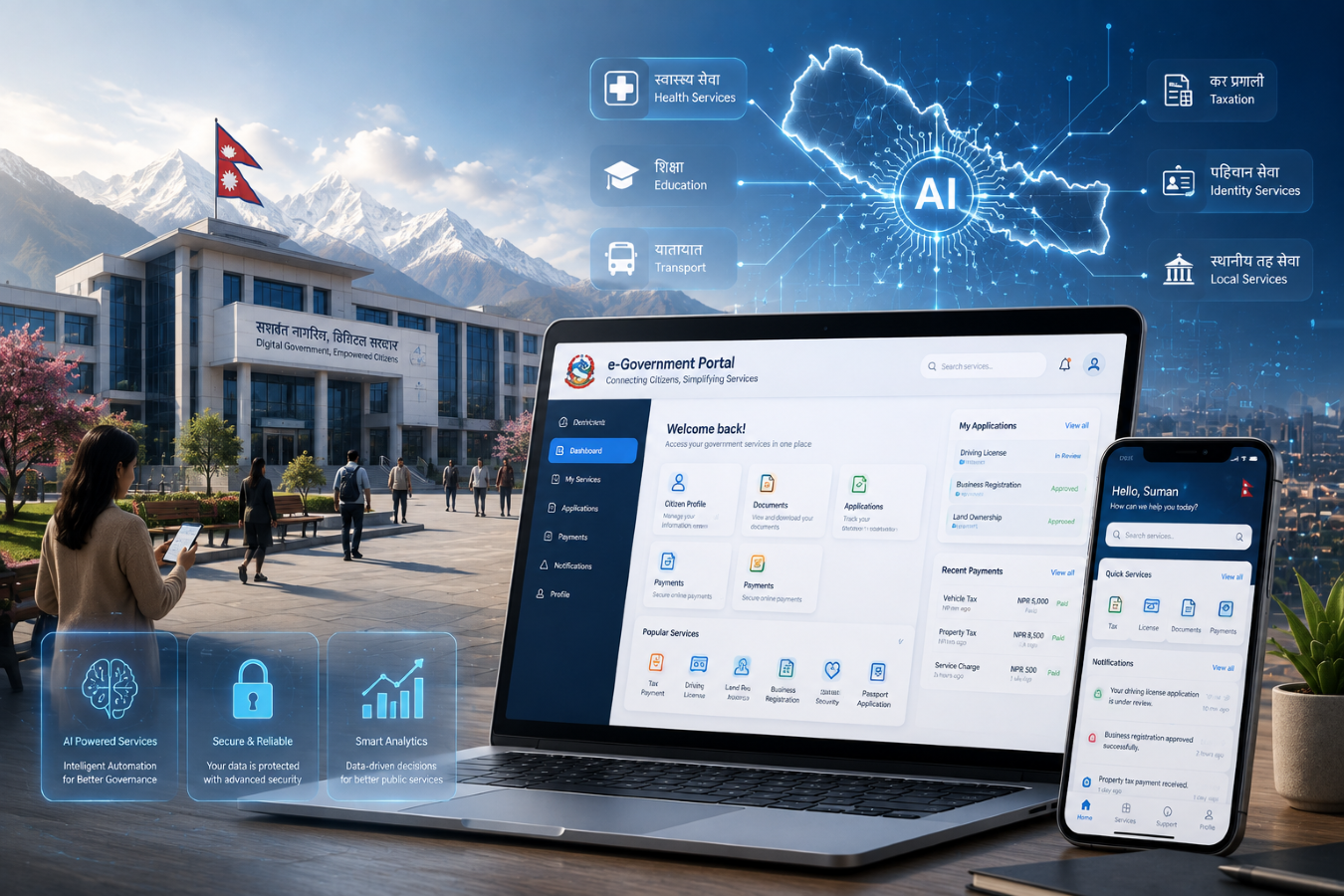
The future of government is not just digital; it is intelligent, predictive, and citizen-centered.
Introduction
Governments across the world are rapidly embracing digital transformation, and artificial intelligence (AI) is becoming one of the most powerful technologies driving this change. From automated citizen services and smart document processing to predictive healthcare, fraud detection, and intelligent traffic management, AI is reshaping how public institutions operate and deliver services.
The shift is no longer theoretical. Recent global research found that more than half of government organizations already use AI in some form, and a growing share have formal AI policies in place, a sign that adoption is moving from pilot projects to everyday operations. Public-sector leaders increasingly expect AI to have a significant, structural impact on how governments work, not just a marginal efficiency gain.
This evolution is happening through e-governance, the use of digital technologies to improve government operations, increase transparency, and make public services more accessible. Today, e-governance is moving beyond simply digitizing paperwork; it is becoming smarter through AI-driven automation, data analytics, and intelligent decision-making systems.
For technology companies specializing in custom software development, AI solutions, automation, cloud platforms, and digital transformation, this shift presents a significant opportunity. At D.Kedar Tech7 Pvt. Ltd., we see AI-powered e-governance as the next stage of digital innovation; one where governments and public institutions can provide faster, more transparent, and more efficient services to citizens through intelligent technology.
What Is E-Governance?
E-governance refers to the use of information and communication technology (ICT) by government organizations to deliver services electronically. Instead of requiring citizens to visit government offices physically, many services can now be accessed through websites, mobile applications, online portals, and integrated digital systems.
Common examples include:
• Online tax filing
• Digital business registration
• Passport and identity services
• Driving license applications
• Utility bill payments
• Land and property registration
• Public grievance systems
• Health and education portals
The primary objective of e-governance is to improve efficiency, transparency, accessibility, accountability, and citizen satisfaction.
However, many government systems still struggle with manual processes, slow approvals, fragmented databases, and increasing administrative workloads. This is where AI becomes transformative.
Why Governments Are Adopting AI
Artificial intelligence enables systems to perform tasks that traditionally required human intelligence, such as understanding language, recognizing images, detecting patterns, making predictions, and supporting decision-making.
Governments are increasingly adopting AI because it helps them:
· Reduce administrative costs
· Automate repetitive processes
· Process documents faster
· Improve citizen service delivery
· Detect fraud and irregularities
· Analyze large volumes of public data
· Support evidence-based policy decisions
· Enhance public safety and emergency response
As citizen expectations for digital services continue to rise, governments need technology that can operate at scale while maintaining speed, accuracy, and consistency. Public-sector leadership surveys consistently point to the same near-term priorities: research and summarization, workflow automation, and content generation are proving to be the highest-value early use cases not because they are the most ambitious applications of AI, but because they deliver measurable, low-risk wins that build institutional trust in the technology.
AI Applications in E-Governance
1. AI-Powered Citizen Service Chatbots
One of the most visible uses of AI in e-governance is the deployment of intelligent virtual assistants and chatbots.
These systems can answer frequently asked questions, provide application guidance, check service eligibility, schedule appointments, track application status, and assist citizens 24/7 without requiring human operators.
For example, a citizen can ask:
· How do I renew my passport?
· What documents are required for business registration?
· When will my tax application be processed?
· How can I apply for government benefits?
Natural language processing (NLP) allows these systems to understand conversational language and respond instantly, reducing waiting times and improving accessibility. Importantly, the goal in mature deployments isn't to replace government staff; it's to redistribute their time toward the complex, judgment-heavy cases that genuinely need a human, while AI absorbs the high-volume, repetitive interactions.
2. Automated Document Processing
Government agencies process enormous numbers of documents every day, including forms, certificates, identity records, contracts, and legal documents.
AI-powered Optical Character Recognition (OCR) and intelligent document processing systems can automatically:
· Extract information from scanned documents
· Validate data fields
· Classify records
· Detect inconsistencies
· Route applications to the appropriate department
This significantly reduces manual data entry, minimizes human error, and speeds up administrative workflows.
3. Fraud Detection and Compliance Monitoring
AI is highly effective at identifying unusual patterns in large datasets.
Governments use AI to detect:
· Tax fraud
· Welfare fraud
· Identity fraud
· Procurement irregularities
· Financial crimes
· Duplicate benefit claims
Machine learning models can analyze transaction histories, application behavior, and network relationships to identify suspicious activities that might otherwise go unnoticed.
4. Predictive Analytics for Public Services
AI enables governments to move from reactive administration to predictive governance.
By analyzing historical and real-time data, governments can forecast:
• Disease outbreaks
• Traffic congestion
• Water and energy demand
• School enrollment trends
• Disaster risks
• Infrastructure maintenance requirements
• Public transportation demand
These insights help public institutions allocate resources more efficiently and respond proactively before problems become critical.
5. AI in Healthcare Governance
Public healthcare systems generate massive amounts of data every day.
AI supports healthcare governance through:
· Disease surveillance
· Medical image analysis
· Hospital resource planning
· Predictive patient risk assessment
· Drug inventory optimization
· Telemedicine support
· Emergency response prioritization
During public health emergencies, AI can help monitor infection trends, identify high-risk regions, and support rapid government decision-making.
6. Smart Cities and Urban Management
AI is becoming a core component of smart city initiatives.
Governments use AI to optimize:
• Traffic signal timing
• Public transportation routes
• Parking management
• Road maintenance planning
• Pollution monitoring
• Waste collection scheduling
• Emergency vehicle routing
• Crowd management
These systems improve urban efficiency while reducing congestion, operational costs, and environmental impact.
The Global Adoption Curve: Where Governments Stand Today
AI adoption in the public sector is accelerating faster than the governance frameworks meant to guide it. International policy research bodies have observed that while the foundational enablers of AI adoption strategies- cloud infrastructure and oversight bodies are maturing in most countries, actual delivery capability remains uneven, and support for AI procurement in particular still lags behind funding commitments.
This gap matters for any organization planning an e-governance AI rollout. It means the technology is ready well before most institutions are, and success depends as much on governance, staff training, and change management as it does on the underlying algorithms. Agencies that formalize AI policy early, focus on a handful of high-impact use cases, and tie initiatives to measurable outcomes cost-to-serve, response times, and staff productivity tend to see the most durable results.
How D.Kedar Tech7 Can Support AI-Powered E-Governance
Implementing AI in government requires more than AI algorithms alone. It requires secure software architecture, scalable cloud infrastructure, workflow automation, mobile accessibility, data integration, and user-centered design.
This is where D.Kedar Tech7 Pvt. Ltd. provides value as a technology partner.
Our expertise in custom software development, AI integration, automation, web and mobile application development, cloud solutions, and digital transformation enables us to help public institutions build intelligent digital ecosystems that improve service delivery and operational efficiency.
We support government agencies, municipalities, provincial administrations, educational institutions, NGOs, and public-sector organizations through:
• Custom e-governance software development
• AI-powered document automation
• Citizen service portals and mobile applications
• Workflow automation systems
• Cloud-based digital infrastructure
• Data analytics and reporting dashboards
• Identity verification systems
• CRM platforms for public service management
• Secure API integration
• AI-enabled digital transformation consulting
Rather than delivering one-size-fits-all software, D.Kedar Tech7 focuses on building solutions tailored to the operational needs of each organization.
Nepal's Opportunity: AI and the Future of Digital Governance
Nepal has already made significant progress through online tax systems, company registration portals, digital payment integration, national identity initiatives, and municipal digital services.
The next step is making these platforms intelligent.
AI can help Nepal improve:
• Municipal service delivery
• Land record verification
• Permit and license processing
• Citizen complaint management
• Healthcare resource allocation
• Disaster response planning
• Agricultural advisory services
• Educational administration
• Public financial monitoring
These are practical software and AI solutions that can be developed today. As Nepal continues to invest in digital infrastructure, technology companies with expertise in AI, automation, cloud systems, and custom software will play a critical role in supporting national and local digital transformation initiatives particularly given that most successful public-sector AI programs elsewhere have relied on external technology partners to bridge the gap between institutional needs and technical execution.
Benefits of AI-Driven E-Governance
- Faster Service Delivery: AI reduces processing times for applications, approvals, document verification, and citizen inquiries, enabling governments to provide services much more efficiently.
- Improved Accuracy: Automated systems reduce human errors in data entry, verification, and administrative processing.
- Better Citizen Experience: AI enables faster responses, multilingual support, personalized services, and round-the-clock accessibility, making government services easier to use.
- Lower Operational Costs: Automation allows government agencies to handle larger workloads without proportional increases in staffing costs.
- Increased Transparency: AI systems improve tracking, reporting, auditing, and monitoring across government operations, strengthening accountability and public trust.
Challenges Governments Must Address
While AI offers significant advantages, governments must also manage important challenges.
- Data Privacy and Security: Government databases contain highly sensitive personal information, making strong cybersecurity, encryption, and privacy compliance essential.
- Algorithmic Bias: AI systems must be trained carefully to avoid unfair or discriminatory outcomes across different communities.
- Transparency of AI Decisions: Citizens should be able to understand how AI systems influence decisions related to applications, benefits, taxation, or public services. This is becoming a formal expectation rather than a best practice: several major regulatory frameworks now require documented oversight and algorithmic accountability for public-sector AI systems, and institutions that build transparency in from the start will be far better positioned to comply.
- Digital Inclusion: AI-powered e-governance must remain accessible to citizens with different levels of digital literacy and internet access.
- Integration with Legacy Systems: Many public institutions still operate older software systems, requiring modernization and integration before AI can be effectively deployed.
The Future of AI-Powered Governance
The next generation of e-governance will become increasingly intelligent, predictive, and interconnected.
Future developments may include:
• AI-assisted policy formulation
• Autonomous administrative workflows
• Voice-based government services
• Digital twins for city planning
• AI-powered legal assistance
• Personalized citizen portals
• Predictive welfare distribution
• Advanced cybersecurity monitoring
• Real-time governance dashboards
• Integrated national data platforms
Governments that successfully combine AI with secure digital infrastructure will be able to deliver faster services, improve public trust, reduce operational costs, and respond more effectively to citizen needs.
Artificial intelligence is transforming e-governance from a digital service platform into an intelligent governance ecosystem. By automating administrative processes, improving decision-making, enhancing citizen experiences, and enabling predictive public services, AI is reshaping how governments operate in the modern era.
For Nepal, this transformation presents a significant opportunity to modernize public institutions through custom software, AI integration, automation, cloud infrastructure, and secure digital platforms.
At D.Kedar Tech7 Pvt. Ltd., we help organizations build future-ready digital solutions that combine software engineering, AI, automation, and digital transformation. Whether you are a government agency, municipality, educational institution, NGO, or enterprise organization exploring AI-powered systems, our team can design and develop scalable solutions that create measurable operational impact.
The future of e-governance is intelligent, and the right technology partner can help build it.