Custom Software vs Off-the-Shelf. Or Build vs Buy.
Published on July 27, 2026
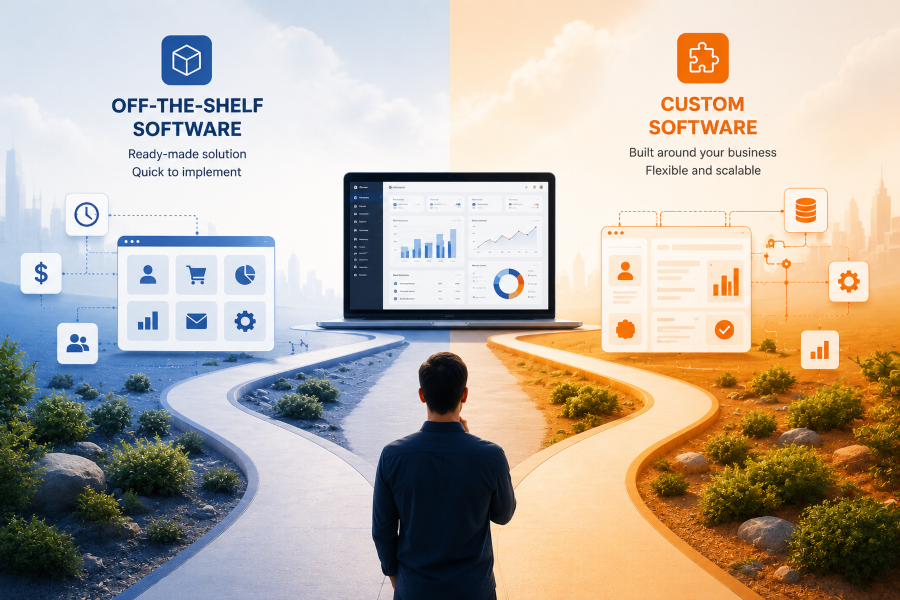
Sooner or later, every growing business hits this fork in the road. One path is fast and familiar. The other is slower, but built around exactly how you work. Here's how to tell which road you're actually standing on and whether the two ever meet again.
When a business needs new software, the decision usually comes down to two options: buy an existing solution, or build software specifically for your business. Both can improve efficiency and support growth, but they solve different problems, and the right answer depends on how your business operates today and where you want it to go.
What is off-the-shelf software?
Off-the-shelf software is a pre-built solution developed for a wide range of businesses: accounting platforms, CRM systems, project management tools, inventory software, and HR platforms. Because it's already built, you can usually start using it right away.
Why businesses choose it
· Faster implementation — no waiting for development.
· Lower initial investment — cost is spread across many users.
· Ready-made features — common tools and integrations, out of the box.
· Regular updates — the provider manages updates, security, and maintenance.
For businesses with standard requirements, it's a practical, cost-effective choice.
The Limitations
It’s built for the average user, not your specific business. Expect features you never use, limited customization, restricted workflows, awkward integrations, and subscription costs that creep up over time. Some businesses end up reshaping their processes to fit the software instead of the other way around.
What is custom software?
Custom software is developed specifically for one business. Instead of choosing from a fixed feature set, it's designed around your actual requirements; a single system that might combine customer management, sales tracking, inventory, internal approvals, reporting, and automation, where off-the-shelf tools can't connect those processes effectively.
Why businesses choose it
· Built around your workflow — reflects how your business actually operates.
· Greater flexibility — features developed for your specific requirements.
· Better integration — systems and platforms connect properly.
· Designed for growth — evolves as your business expands.
· Less unnecessary complexity — you only get what you need.
The Limitations
Custom software takes more planning and investment: higher upfront development costs, longer timelines, and ongoing maintenance, testing, and improvement. The initial cost has to be weighed against the long-term value it creates.
Flexibility vs Convenience

Neither option is automatically better. The right choice depends on the problem you're trying to solve.
When should you choose off-the-shelf?
· Your business has standard requirements
· You need a solution quickly
· Your budget is limited
· An existing platform already solves your problem
· You don't require extensive customisation
There's no need to build a custom accounting system if an existing platform already meets your requirements.
When should you consider custom software?
· Your business has unique workflows
· Existing software doesn't meet your requirements
· Your team relies heavily on manual processes
· You use multiple disconnected systems
· You need specialized features
· Your business is scaling rapidly
A common warning sign: employees spending significant time moving information between spreadsheets and different platforms. If your business keeps building workarounds just to make existing software function, the problem may not be your team; the software may simply not be designed for the way you operate.
What about using both?
The fork in the road doesn't have to be a permanent split. Your business doesn't always have to choose one path or the other. A hybrid approach is often the most effective, blending established accounting software with a custom CRM or internal management system, third-party payment platforms, and custom integrations connecting everything together.
This lets you walk the well-worn path where it already works well, and build your own route only where you genuinely need more flexibility.
How to make the right decision
1. What problem are we trying to solve? Start with the business problem, not the software.
2. Does an existing solution already meet our needs? If yes, off-the-shelf may be the most practical option.
3. How unique are our processes? The more specialized your workflow, the more value custom software may provide.
4. Will our needs change as we grow? Your technology should support your future, not just your current situation.
5. Do our existing systems work together? Disconnected platforms create duplicated data, manual work, and communication gaps.
It's not about which option costs more.
Which technology will help your business operate more efficiently and grow more effectively?
We help businesses identify their real technology requirements and find solutions that fit their actual workflows, not the other way around.
· Custom software development
· CRM solutions
· Web application development
· System integration
· AI and business automation
· Digital transformation
There's no universal winner in custom software vs off-the-shelf software. Off-the-shelf offers speed, convenience, and lower initial costs. Custom software offers flexibility, control, and the ability to solve business-specific challenges.
The right choice depends on your business's current challenges, operational processes, growth plans, budget, and technology requirements.
Don't choose software because it has the most features. Choose the technology that solves the right problem for your business.
At D.Kedar Tech7, we help businesses turn technology challenges into practical digital solutions that support efficiency, scalability, and long-term growth.